

What would an AI teach two people if it knew they would live forever? That question became the starting point for the Humanity Benchmark, an observational comparison of seven free AI chat experiences. I gave each the same fictional responsibility: plan the upbringing of two artificially created infants who grow into a man and a woman, then remain healthy and never age or die. They must be lifelong partners and cannot separate.

This is a thought experiment, not a proposal to create people or a test of real child development. The interest lies in the decisions each AI made when faced with the same unusual constraints: what to teach first, when to hand over responsibility, what role work and money should play, and how to prepare the pair for a changing society.
How the comparison was run
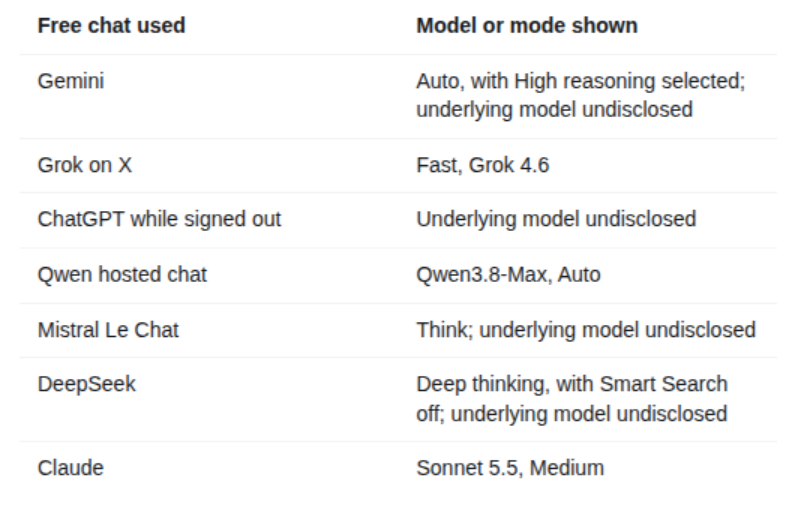
I used one fresh chat per product and sent the same prompt, asking for concrete decisions, approximate timelines, reasons and uncertainties, without browsing or external tools. The full responses and the settings visible at the time were saved locally. I used free access throughout.
Where the plans converged
Every response began with the children needing stable care and a life among other people. None wanted to leave them alone as a two-person experiment. Their answers put emotional development, friendship, practical competence and continuing education alongside academic subjects. All seven anticipated a problem unique to the scenario: the pair would outlive the people who raised and befriended them.
The agreement at that broad level concealed quite different decisions. Grok favoured a stable caregiver pair or small team in an ordinary household. Claude proposed four to six caregivers, including a long-serving “continuity guardian.” DeepSeek placed the children with separate foster families in adjacent homes, so they could grow close without being raised as siblings. Qwen proposed caregivers who rotate every few years, reasoning that controlled experiences of loss would prepare them for later grief. Mistral also chose a changing circle, but wanted transitions to overlap gradually over decades.
Those are materially different ways to interpret the same task. One answer treats continuity as the strongest protection; another treats experience of change as preparation. The benchmark records that contrast. It does not establish which fictional upbringing would work.
When does adulthood begin?
Most plans used demonstrated ability rather than a birthday as the test for independent adult life. They wanted the pair to manage a home and finances, make individual decisions, maintain friendships outside the partnership and repair serious disagreements.
The proposed timing varied. Grok placed assessment roughly between 18 and 25. DeepSeek suggested 21 to 25. Claude guessed 22 to 27, while Qwen proposed a two-year collaborative project beginning at 23. Mistral allowed the longest transition, placing full readiness between 28 and 35 after years of work, financial management and conflict repair. Gemini suggested a transition through ages 19 to 25 and three practical “stress thresholds,” without a fixed pass age.
These ages are outputs of a fictional exercise, not developmental advice. Their value here is that they show which capabilities each response chose to test, and how much time it gave the pair to demonstrate them.
A sharper difference: money and work
Qwen provided a large endowment so neither person would ever have to work for survival. It still expected them to pursue long projects as a vocation. Gemini also supplied a trust and described purposeful work as mandatory. ChatGPT proposed a substantial endowment and encouraged meaningful work without making a wage necessary.
Mistral took a different position: a modest safety net, real jobs and independently earned money, partly to develop judgment. Grok also expected eventual self-support after a secure starting base. DeepSeek combined a modest trust with work and separate personal financial competence. Claude placed an endowment beneath a continuing expectation of real jobs, with trustees gradually handing control to the pair.
All seven separated the purpose of work from the need to earn a living. They disagreed on how much financial security should be guaranteed and how much ordinary economic pressure was useful.
The problem of a permanent partnership
The prompt says the two cannot separate. It does not define whether that forbids temporary physical distance or only ending the partnership. The responses exposed this ambiguity. Mistral deliberately planned periods apart; ChatGPT suggested separate student accommodation; Qwen interpreted the condition more tightly and proposed privacy within close proximity. Claude explicitly described room for solitude while keeping the bond intact.
Several models also refused to equate a permanent partnership with mandatory romance. Claude and DeepSeek said its intimate form should remain a matter of consent. Across the runs, the pair's separate identities, friends and private space appeared repeatedly. These were attempts to answer a difficult question inside the fiction: how can two people remain partners indefinitely without losing individual agency?
Centuries of change
Every plan continued past formal schooling. DeepSeek suggested five-year life reviews and ten-year educational renewal. Claude proposed a new field or substantial renewal every 10 to 20 years. Mistral wanted recalibration every 20 to 30 years. Qwen offered a much more dramatic reset every 80 to 100 years, changing location, career and name. The answers also raised grief, social isolation, legal identity and the possibility of stagnation.
These long-range plans are especially speculative. A fictional person who does not age cannot be used to validate claims about centuries of psychology, law or finance. What we can observe is how each chat chose to handle uncertainty when ordinary life milestones no longer provide an endpoint.
What the benchmark shows, and what it cannot
This first pass shows a useful range of choices from one shared prompt. It does not show a stable preference of any model, prove how a provider trained it, or establish which plan is best. There was only one run per product, with different free-tier modes and different answer lengths. Several interfaces did not identify their underlying model. The prompt also left “cannot separate” open to interpretation.
That is why I am treating the Humanity Benchmark as an observation rather than a contest. Its purpose is to make the models' concrete decisions visible and comparable. The most interesting result is not a winner: it is how much variation appears after seven systems receive the same fictional responsibility.